menu
home
tools manual
lessons
generator
gallery
dscript.org
|
 |
|
Applications
There are several main areas where Dscript can be particularly usefull.
Fantasy / sci-fi
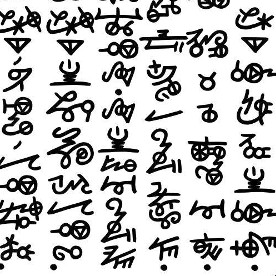
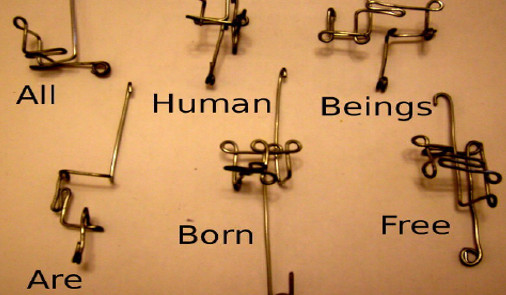
Dscript can be employed in any designs (eg. art, shows, games, puzzles, books, etc...) that need an alien or mystical appearance to some text. Because basic English appears so drastically different when written in Dscript it is not necessary to design and entire language, but if one does it can also be written in Dscript if it is designed to use the Roman alphabet. If Dscript is used to present English text it also gives the viewer/player the chance to decode it.
Decoding Dscript without the manual would be much more difficult than most current mythical fonts because the words merge into what seem to be symbols. The merged letters of a word often create the illusion of a symbol or glyph so it would not be as simple as associating 26 symbols to their corresponding letters, at first glance it would appear as though there were hundreds, if not thousands, of unique glyphs. However after some study the pattern can be discovered because all the composite letters of a word, and their sequence, are always distinguishable.
Graphics/logos
Dscript is well suited for many form of graphics design, especially logo design. A corporate name or abbreviation, for example, if written in Dscript often creates an elegant glyph perfectly suited for use as a logo or emblem.
Privacy
Although the Dscript manual is publicly available it still requires quite a bit of study to learn to read it. I highly doubt it has any chance of acquiring any real level of universality, except maybe in some small groups of specific individuals, so even though it would not provide an "unbreakable code" it would definitely significantly limit the number of people capable of reading it.
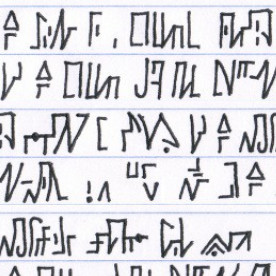
Dscript would provide some level of privacy when taking notes in a public setting, such as on the bus or in a meeting. It would also be well used for writing a diary if it is feared that other members of the household may try to read it. A user of Dscript would probably have a pretty good guess as to whether anyone in the vicinity may know or be able to learn Dscript. Even if someone found a diary written in Dscript and was motivated enough to download the manual and attempt deciphering it, it would require a great deal of time to read and could not be skimmed quickly, likely dissuading them from reading much of it.
Dscript would also be extremely difficult to OCR, so it would require alot of human time to extract any information.
Finally, because Dscript allows for so many possible forms of most words, each user would develop his or her own style that would slow down others attempts to read their writing. This is like how it is often hard to read anothers handwriting, but also amplified because there are choices as to which form of each word to use.
When needed to be more universally legible there are "standard forms" of each word. This is simply the form that uses the most basic combinations, separates syllables and saves strokes best.
Arrays and multidimensional information
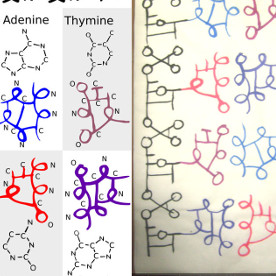
Dscript can do something other Roman alphabet scripts cannot, it can be written vertically and horizontally with all letters of a word connected. This means that information can be drawn in 2 dimensions.
Unlike conventional cursive scripts, Dscript can be written both vertically and horizontally, and unlike standard non-cursive scripts there is no concern about confusing which word an individual letter belongs to.
 PDF file format, right click and "save as" to download
|
|